Underwater Lighting and Illumination
- -->> 5. Underwater Lighting and Illumination
What you'll learn
 Physics of Underwater LightNatural IlluminationArtificial Lighting TechniquesLight Control Strategies
Exploring the underwater world reveals a unique interplay of light, vastly different from terrestrial environments. Understanding how light behaves beneath the surface, both natural and artificial, is paramount for anyone keen to observe, document, or capture its beauty effectively. This guide delves into the science of light in water, its various manifestations, and the techniques to harness it for stunning results, enhancing both observation and imaging.
The Physics of Light in Water
Water, a dense medium, dramatically alters light's properties. Unlike air, water absorbs, scatters, and refracts light in significant ways, fundamentally changing its appearance and availability.
Absorption: As light penetrates water, certain wavelengths are absorbed more rapidly than others. Red light is the first to disappear, typically gone within the first 15-20 feet, followed by orange, yellow, and green. Blue light penetrates deepest, which is why the ocean often appears blue. This color absorption means subjects at depth will naturally lack vibrant reds, oranges, and yellows unless artificial light is introduced.
Scattering: Water contains countless particles – sediment, plankton, and dissolved organic matter. These particles cause light to scatter, reducing overall clarity and contrast. When light from a camera's flash or video light hits these particles directly in front of the lens, it creates "backscatter," appearing as distracting bright spots in images.
Refraction: Light bends as it passes from one medium (air) to another (water) due to a change in speed. This phenomenon, known as refraction, causes objects underwater to appear approximately 25% larger and closer than they actually are. It also affects the angle of view of lenses, making them narrower, effectively increasing their focal length.
Natural Ambient Light Underwater
The quality and quantity of natural light available underwater are influenced by several critical factors.
- Depth: The most significant factor. As discussed, colors are lost with increasing depth, and the overall light intensity diminishes exponentially.
- Time of Day: Midday offers the brightest, most direct light penetration. Early morning and late afternoon light, while beautiful on land, is quickly lost and absorbed underwater due to its shallower angle of entry.
- Water Clarity: Clear water allows for deeper light penetration and less scattering. Murky water significantly reduces ambient light and increases visible backscatter.
- Surface Conditions: Waves and ripples on the surface act like countless lenses, focusing and diffusing light, creating dynamic light patterns but also reducing consistent light availability. Overcast skies also reduce overall light reaching the surface.
Artificial Light: Strobes and Video Lights
To overcome the limitations of natural light, artificial light sources are indispensable for achieving high-quality underwater photography and videography.
Purpose: Artificial light serves multiple critical functions:
- Restoring Color: Bringing back the reds, oranges, and yellows lost to water's absorption.
- Creating Contrast and Dimension: Adding shadows and highlights to give subjects shape and depth, making them stand out from the background.
- Freezing Motion: With strobes, the brief, powerful flash can effectively freeze the motion of fast-moving subjects, preventing blur.
Types of Artificial Light:
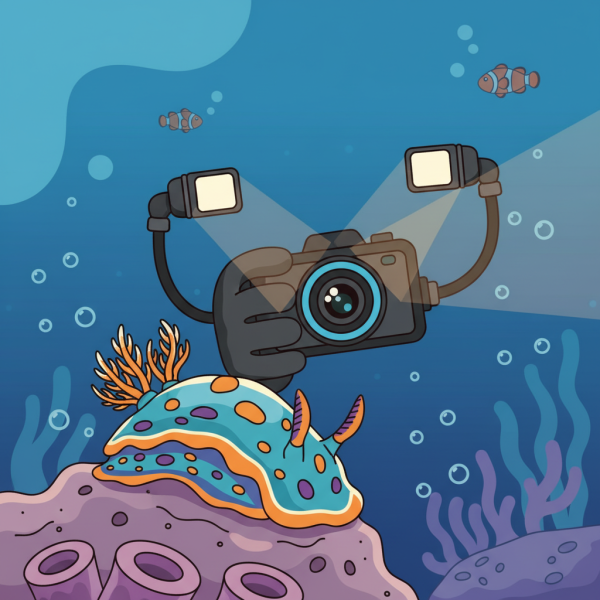
- Strobes: Primarily used for still photography, strobes emit a powerful, brief burst of light. They are synchronized with the camera's shutter and are ideal for wide-angle and macro photography.
- Video Lights: Provide continuous illumination, essential for videography, and are also highly useful as focus lights for still photography, especially in low-light conditions.
Positioning for Success: Proper placement of artificial lights is crucial for optimal results.
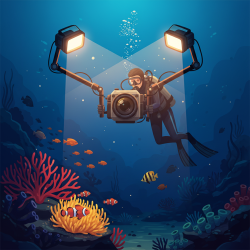
Avoiding Backscatter: The key is to position strobes or video lights away from the camera's lens axis, typically out to the sides and slightly behind the lens port. This way, the light hits the subject directly, but the light reflecting off particles in the water column directly in front of the lens goes past the lens, rather than into it.
Achieving Dimension: Using two strobes allows for more creative lighting, creating natural-looking shadows and highlights that give subjects a three-dimensional look. A single strobe can also be effective when positioned carefully to sculpt the subject and avoid flat lighting.
Balancing: The goal is often to balance artificial light with ambient light, illuminating the subject while maintaining the natural feel and exposure of the background, creating a more cohesive image.
Controlling Light Effectively
Effective light control is an art that combines technical understanding with creative vision, ensuring your subjects are perfectly illuminated.
Strobe Power and Direction: Adjusting strobe power allows fine-tuning of exposure on your subject. Directing the strobe head can create different lighting effects, from broad, even illumination to targeted spotlighting. Many strobes offer manual power control, while some feature automatic TTL (Through-The-Lens) modes that attempt to calculate optimal flash output based on the camera's meter.
Diffusers and Snoots:
- Diffusers: Soften the light, reducing harsh shadows and creating a more even spread. They are particularly useful for wide-angle shots or when working with reflective subjects.
- Snoots: Narrow the light beam into a precise, concentrated spot, ideal for highlighting small subjects against dark backgrounds, creating dramatic spotlighting effects, or for creative lighting.
Camera Settings for Light Control:
- ISO: Controls the camera's sensitivity to light. Lower ISO (e.g., 100-200) minimizes digital noise but requires more light. Higher ISO is useful for ambient light shots but introduces more noise.
- Aperture (f-stop): Controls depth of field and the amount of light entering the lens. A wider aperture (smaller f-number) lets in more light and creates shallower depth of field, ideal for isolating subjects.
- Shutter Speed: Controls how long the sensor is exposed to light. Faster shutter speeds freeze motion. For ambient light, slower speeds can gather more light for the background, but may introduce blur. When using strobes, shutter speed primarily controls the ambient light exposure, not the strobe's exposure (which is determined by its flash duration and power).
Balancing Natural and Artificial Light: This is a cornerstone of advanced underwater imaging. The common technique involves using shutter speed to control the background (ambient light) exposure and aperture/strobe power to control the foreground subject (strobe light) exposure. This allows for beautifully lit subjects against naturally exposed, vibrant backgrounds.
Summary
Understanding light's unique behavior in water—its absorption, scattering, and refraction—is fundamental for anyone venturing into the aquatic realm. Natural ambient light diminishes and changes color with depth, necessitating the judicious use of artificial light sources like powerful strobes and versatile video lights to restore vibrancy and create essential dimension. Mastering the proper positioning and power of these lights, along with appropriate camera settings, allows for effective light control, enabling the capture of stunning, well-illuminated underwater scenes that accurately reflect the profound beauty beneath the waves.
Comprehension questions
 What three primary ways does water alter the properties of light, and how does each affect underwater visibility or color?Name three environmental factors that significantly influence the quality and quantity of natural ambient light available underwater.Why is proper positioning of artificial lights crucial for avoiding backscatter in underwater photography, and how is it typically achieved?How do shutter speed, aperture, and strobe power collectively work to balance natural and artificial light in an underwater photograph?