
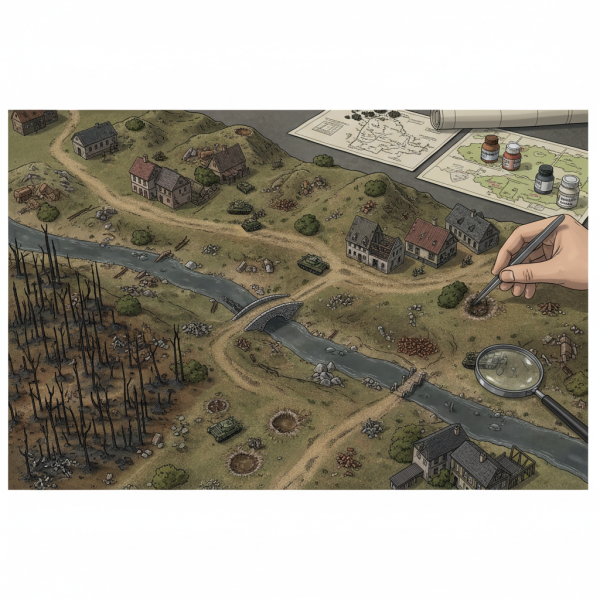
The Miniature Battlefields of 1:285 Scale Terrain Builders
What you'll learn
 The significance of 1:285 scale in wargaming.The critical role of historical research in terrain building.Multi-stage construction techniques for realistic landscapes.The educational and artistic value of hyper-accurate terrains.
Stepping onto a miniature battlefield is more than just playing a game; for some, it's an immersive journey into history, meticulously recreated down to the smallest detail. This article explores the fascinating world of miniature wargaming terrain builders, particularly those dedicated individuals who invest countless hours, often years, into constructing hyper-accurate, weathered 1:285 scale landscapes of specific historical battles. These aren't just game boards; they are living, breathing historical dioramas, designed to transport players and observers directly into the heart of past conflicts.
The Art of Miniature Wargaming Terrain
Miniature wargaming has been a popular hobby for decades, allowing enthusiasts to recreate historical, fantasy, or science fiction battles using small figures. While the figures themselves are often beautifully painted, it's the terrain that truly sets the scene. For a select group of hobbyists, the terrain isn't merely background; it's the main event, demanding an unparalleled level of dedication and craftsmanship. They seek to capture not just the topography, but the very essence and atmosphere of a historical moment.
Why 1:285 Scale?
The 1:285 scale, often referred to as 6mm, is a favored choice for recreating large-scale historical battles. At this scale, individual vehicles and infantry models are tiny, making it possible to represent vast armies and expansive battlefields within a manageable physical space. This scale allows for a comprehensive overview of troop movements and strategic positions that would be impractical in larger scales. It also lends itself well to representing the entire scope of historical engagements, from company to divisional levels, making the grand narrative of battle truly visible.
Research and Authenticity
The cornerstone of hyper-accurate terrain building is exhaustive research. These builders delve deep into historical archives, studying period maps, aerial photographs if available, soldier accounts, and topographical surveys. They analyze satellite imagery, geological data, and even climate patterns of the time to understand the terrain's composition, vegetation, and how natural elements might have influenced the battlefield. Every hill, river, forest, and building must be placed with historical precision, reflecting its exact location and appearance during the specific battle date.
Authenticity extends beyond placement. The type of trees, the texture of fields, the architectural style of buildings, and even the seasonal conditions are carefully considered. Was it a dry summer day, leading to dusty roads, or a muddy winter landscape? Such details are critical for a truly immersive and educational experience. This level of forensic detail transforms the hobby into a form of practical historical scholarship.
The Construction Process
The actual construction of a 1:285 scale historical battlefield is a multi-stage process, demanding a diverse skill set. It begins with a robust base, often plywood or foam insulation, precisely cut and leveled according to topographical maps.
- Layering and Elevation: Contours are built up using foam, cork, or even plaster, meticulously sculpted to match the elevation changes.
- Surface Texturing: The raw landscape is then covered with various textures: fine sand for dirt roads, static grass for fields, miniature trees and shrubs for forests, and realistic water effects for rivers and ponds.
- Weathering and Detailing: This is where the landscape truly comes alive. Dust, mud, shell craters, burnt ground, and rubble are added to show the wear and tear of battle and the passage of time. Buildings are weathered with subtle paint effects, depicting chipped plaster or stained brick.
- Strategic Elements: Roads, bridges, fortifications, and other man-made structures are carefully scratch-built or sourced, ensuring they match the historical period and location.
Tools and Materials
A specialized toolkit is essential for these demanding projects. Builders utilize a range of hobby knives, sculpting tools, airbrushes for subtle color transitions, and various applicators for flock and static grass. Materials are equally diverse, including high-density foam, plaster of Paris, various glues and adhesives, acrylic paints, pigments for weathering, and a vast array of scenic products like static grass, miniature trees, and realistic water resins. The choice of materials is often dictated by their ability to accurately represent natural elements at such a small scale.
Challenges and Rewards
The challenges are numerous: sourcing obscure historical data, mastering various crafting techniques, and maintaining motivation over long construction periods. Miniaturizing complex geological features or urban environments accurately at 1:285 scale requires immense patience and skill. However, the rewards are equally significant. The sense of accomplishment upon completing a historically accurate, immersive battlefield is profound. These terrains often become educational tools, sparking conversations about historical events and geographical significance. They serve as tangible links to the past, allowing for a deeper understanding of historical contexts.
Beyond the Battlefield
These hyper-accurate terrains often transcend their original purpose as wargaming surfaces. They are frequently displayed at conventions, museums, and historical society events, serving as dynamic educational exhibits. They offer a unique perspective on historical battles, providing a three-dimensional map that helps visualize the movements and challenges faced by combatants. For many, the act of building becomes a meditative and scholarly pursuit, a way to connect deeply with history through artistic expression.
Conclusion
The construction of hyper-accurate, weathered 1:285 scale historical battle terrains is a testament to extraordinary dedication and passion. It blends meticulous historical research with advanced artistic craftsmanship, resulting in breathtaking miniature landscapes that are both engaging wargaming environments and powerful educational tools. These builders transform historical data into tangible, immersive experiences, reminding us that even the smallest details can bring the grand narratives of the past vividly to life for an online learning community and beyond.
Comprehension questions
 What scale is primarily discussed in the article for recreating large-scale historical battles, and why is it favored?What kind of historical sources do hyper-accurate terrain builders consult to ensure authenticity?Name three distinct stages involved in the construction process of a miniature historical battlefield.Beyond wargaming, what other roles or functions do these hyper-accurate terrains often serve?