
The Science of the Dry Rub: Unlocking Flavor and Perfecting Bark
What you'll learn
 Salt's Role in Bark FormationSugar's Impact on Flavor and ColorSpices and Aromatic ContributionsThe Science of Bark Development
How Dry Rubs Transform Your BBQ
For any outdoor cook who revels in the art of BBQ and smoking, the dry rub is more than just a seasoning; it's the secret alchemical key to a truly unforgettable experience. It's the silent workhorse that builds flavor, creates that tantalizing crust, and locks in moisture. But have you ever stopped to consider the intricate science unfolding on the surface of your meat as those simple granules of salt, sugar, and spice begin their work? Beyond mere taste, a complex interplay of chemical and physical reactions crafts the coveted, savory, and often pressurized "bark" that defines exceptional barbecue. Understanding this science elevates your cooking from guesswork to mastery, empowering you to consistently produce perfect results.
Salt's Crucial Role
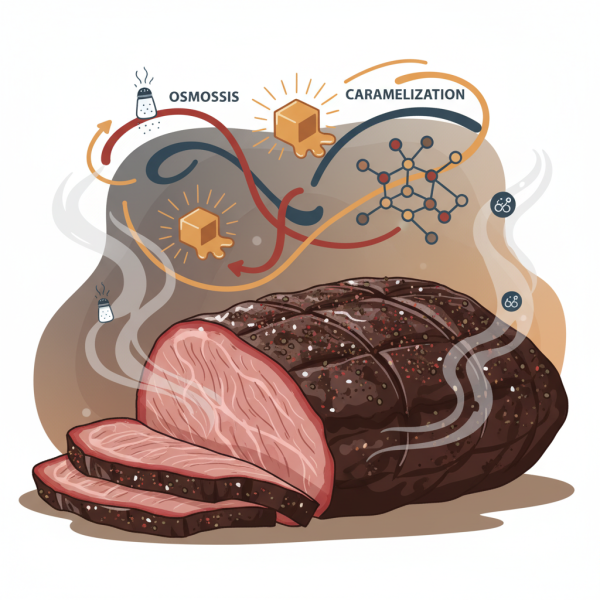
Salt is not just for seasoning; it's the undisputed MVP of any dry rub, initiating a cascade of reactions that are fundamental to bark development and overall flavor. Its primary role begins with osmosis. When salt is applied to the surface of the meat, it draws out moisture from the muscle fibers. This initial moisture then dissolves the salt, creating a highly concentrated brine on the surface.
This salty liquid is then reabsorbed by the meat through diffusion, carrying flavor deep into the muscle. This process is often called dry brining. Beyond moisture movement, salt also denatures proteins, essentially uncoiling them. This changes the meat's texture, making it more tender and improving its ability to retain moisture during the long cooking process. The initial crust that forms before true bark development largely begins with the presence of salt interacting with the meat's surface proteins and moisture.
Sugar's Contribution to Color and Crust
While salt lays the groundwork, sugar steps in to play a vital role in color, flavor, and bark formation. Sugar, whether it's granulated, brown, or turbinado, contributes primarily through two key chemical reactions: caramelization and the Maillard reaction.
- Caramelization: As sugar heats to high temperatures (typically above 320°F or 160°C), it undergoes a complex series of reactions, breaking down and reforming into hundreds of new compounds. This creates the characteristic nutty, rich, and slightly bitter flavors and, crucially, the beautiful dark brown color that is a hallmark of good bark.
- Maillard Reaction: This reaction occurs between amino acids (from the meat's proteins) and reducing sugars at temperatures generally above 285°F (140°C). It's responsible for the complex, savory, roasted flavors and the deep brown hues that are synonymous with perfectly cooked meat. Sugar in the rub significantly boosts the intensity and speed of the Maillard reaction on the surface.
It's a delicate balance, however. Too much sugar, or cooking at excessively high temperatures, can lead to burnt, bitter flavors before the meat is fully cooked. Different sugars also have varying caramelization points and flavor profiles, allowing for fine-tuning of your rub.
Flavor, Aroma, and Bark Texture
The vast world of spices adds layers of complexity, aroma, and even contributes to the physical properties of the bark. Spices, like paprika, black pepper, garlic powder, onion powder, and chili powders, contain a multitude of volatile organic compounds that release their aromatic magic when heated. These compounds undergo their own transformations, interacting with the meat and other rub ingredients to create a unique flavor profile.
Beyond flavor, spices also play a textural role. The particulate matter from ground spices adheres to the meat's surface, creating a more substantial and complex bark layer. Finer ground spices will integrate more seamlessly, while coarser spices can add a desirable gritty texture. The choice of spices and their grind size can significantly influence both the taste and mouthfeel of your final product.
The Bark Formation Phenomenon
The formation of the much-revered bark is a multi-stage process that combines the actions of salt, sugar, spices, and the cooking environment, particularly smoke. It's not just a crust; it's a dehydrated, flavorful layer that acts almost like a protective shell.
- Initial Drying: Heat from the smoker or grill causes the surface moisture of the meat (including the dissolved rub) to evaporate. This drying concentrates the rub ingredients on the surface.
- Polymerization and Cross-Linking: As proteins denature and moisture leaves, the dissolved sugars and spices, along with rendered fats, begin to polymerize – forming larger, more complex molecules. These molecules create a sticky matrix that binds to the meat's surface proteins.
- Maillard and Caramelization: As temperatures rise, the Maillard reactions between amino acids and sugars, and the caramelization of sugars themselves, kick into high gear, contributing significantly to the bark's color, flavor, and rigidity.
- Smoke Interaction: Smoke particles (phenols, guaiacol, syringol, etc.) adhere to the sticky surface of the developing bark. These compounds add distinct smoky flavors and contribute to the dark, rich color, further enhancing the bark's complexity and depth.
- Dehydration and Hardening: Over hours of low-and-slow cooking, the surface continues to dehydrate, solidifying the interwoven layers of protein, sugar, spice, and smoke into a firm, crisp, and flavorful bark.
Comprehension questions
 How does salt contribute to both the flavor and the initial crust formation in a dry rub?What two chemical reactions are primarily driven by sugar in a dry rub, and what do they contribute to the bark?Why is patting meat dry before applying a dry rub considered an important step for bark development?