
Morris Dancing: An English Folk Tradition
What you'll learn
 The Roots of Morris DancingKey Characteristics and StylesThe Dancers and the CommunityWhy Morris Dancing Endures
Morris Dancing is a vibrant and enduring form of English folk dance, instantly recognizable by its rhythmic stepping, intricate choreographed figures, and the distinctive sound of bells worn by the dancers. This traditional art form, deeply woven into the cultural fabric of England, involves groups of performers known as 'sides' who execute synchronized movements, often accompanied by live music. Far from being a relic of the past, Morris dancing continues to thrive, celebrated for its community spirit, historical richness, and the sheer joy it brings to both participants and audiences. For anyone looking to understand a unique aspect of English heritage, delving into the world of Morris dancing offers a fascinating journey.
The Roots of Morris Dancing
The precise origins of Morris dancing are shrouded in the mists of time, making it a subject of much scholarly debate and folkloric speculation. While its exact beginnings remain unconfirmed, several theories offer intriguing insights into its historical development. Many believe the dance dates back to medieval times, with some suggestions pointing to pagan fertility rituals, given its traditional performance in spring and early summer.
Another popular theory proposes a connection to 'Moorish' dances, suggesting a possible influence from Spanish or European court dances that may have spread to England. This theory aligns with the term 'Morris' itself, which some believe is a corruption of 'Moorish'. Regardless of its exact etymology, the dance form became firmly established in England by the 15th century, with early written records referencing its presence in various festivities.
Over the centuries, Morris dancing evolved, adapting to local customs and social changes. It experienced periods of decline, particularly during the Puritan era when many traditional entertainments were suppressed, but always found ways to resurface. The late 19th and early 20th centuries saw a significant revival, largely due to figures like Cecil Sharp, who meticulously documented and collected traditional tunes and dances from surviving practitioners in rural villages.
Key Characteristics and Styles
Morris dancing is not a monolithic entity; it encompasses a variety of regional styles, or 'traditions,' each with its own distinctive characteristics in terms of steps, music, costume, and even the props used. Despite these differences, common elements unite the various forms, creating a recognizable dance genre.
Common characteristics typically include:
- Rhythmic Footwork: Dancers execute precise, often energetic steps, with bells usually strapped to their shins, accentuating the rhythm.
- Choreographed Figures: Dances involve specific patterns and formations, such as lines, circles, and intricate weaving movements.
- Props: Handkerchiefs and sticks are the most common props. Handkerchiefs are waved to emphasize arm movements, while sticks are clapped together rhythmically.
- Music: Live music is integral, commonly featuring instruments like the melodeon, accordion, fiddle, pipe and tabor, or concertina.
Among the most widely recognized traditions are:
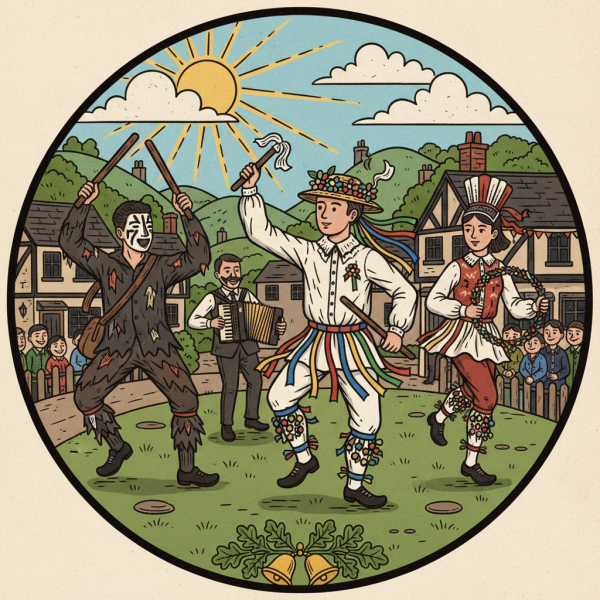
The Cotswold Morris is perhaps the most famous, originating from the Cotswold hills of England. Dancers typically wear white clothing, often with colourful sashes, ribbons, and flowered hats. Handkerchiefs and sticks are frequently used, and the style is characterized by its relatively intricate footwork and often jaunty, athletic performance.
Border Morris, from the English-Welsh border counties, is known for its darker, often ragged costumes, sometimes with painted faces. The dancing tends to be more vigorous, even wilder, with heavy stick clashing and simpler, more powerful steps. The music often has a raw, driving quality.
North West Morris hails from the mill towns of Lancashire and Cheshire. This style is often processional, with dancers wearing clogs and frequently adorned with elaborate hats or bonnets and brightly decorated sashes. The steps are often more formal and precise, with a focus on marching and intricate patterns.
The Dancers and the Community
Morris dancing is inherently a communal activity. A group of dancers is known as a 'side' or 'club', and each side typically comprises not just the dancers, but also a musician or several musicians, and often other traditional figures like a 'Fool' (who interacts with the crowd) and a 'Bagman' (the secretary or organizer). The practice is deeply rooted in local communities, with knowledge and dances often passed down through generations.
Becoming a Morris dancer is more than just learning steps; it's joining a social network built on shared tradition and camaraderie. Sides practice regularly, often in village halls or pubs, honing their routines and preparing for performances. These performances are a highlight, taking place at village fetes, folk festivals, historical reenactments, and traditional events like May Day celebrations or Boxing Day. The joy of performing, sharing the tradition, and being part of a living heritage is a powerful draw for many participants.
The community aspect extends beyond individual sides. The broader Morris dancing world is connected through national organizations and a circuit of festivals where different sides gather, perform, and learn from one another. This fosters a vibrant exchange of ideas and a strong sense of collective identity among practitioners.
Why Morris Dancing Endures
Despite its ancient roots, Morris dancing continues to capture imaginations and attract new practitioners in the 21st century. Its endurance can be attributed to several factors that resonate deeply with individuals and communities today.
Reasons for its continued popularity include:
- Preservation of Cultural Heritage: It offers a tangible link to England's past, providing a way to keep traditions alive and connect with history.
- Community and Social Connection: In an increasingly digital world, Morris dancing provides a genuine, in-person community and a strong sense of belonging.
- Physical and Mental Benefits: The dancing offers excellent physical exercise, improving coordination, stamina, and memory, while also providing a creative outlet.
- Joy and Performance: There is immense satisfaction in mastering a dance, performing for an appreciative audience, and sharing in the collective energy of a 'side'.
- Adaptability: While rooted in tradition, Morris dancing is not static. New sides form, existing ones evolve, and there's a dynamic interplay between preserving authenticity and allowing for creative expression.
Its vibrant presence in modern society demonstrates that traditional arts can thrive when nurtured by passionate individuals and supported by an appreciative community.
Summary
Morris dancing is a dynamic English folk tradition characterized by rhythmic stepping, choreographed figures, and the sound of bells. The article explored its mysterious historical origins, tracing its presence back to medieval times and noting its 20th-century revival. We delved into the distinct regional styles, such as Cotswold, Border, and North West Morris, highlighting their unique costumes, music, and dance characteristics. The communal nature of Morris dancing was emphasized, detailing the roles within a 'side' and the strong social bonds forged through practice and performance. Finally, the enduring appeal of Morris dancing was discussed, attributing its longevity to its role in cultural preservation, community building, and the enjoyment it brings to participants.
Comprehension questions
 What are the two main theories discussed regarding the origins of Morris dancing?Name and describe two distinct regional styles of Morris dancing mentioned in the article.What common characteristics unite the various forms of Morris dancing, including props and music?According to the article, what are some key reasons for Morris dancing's continued endurance and popularity in the 21st century?