Strobes and Video Lights in Underwater Photography
- -->> 3. Strobes and Video Lights in Underwater Photography
What you'll learn
 Underwater Color LossStrobe Photography TechniquesVideo Light ApplicationsOptimizing Light Placement
Underwater photography presents a unique set of challenges, particularly when it comes to capturing the vibrant spectrum of marine life and environments. As light penetrates the water column, it undergoes significant absorption, leading to a dramatic loss of color, especially reds, oranges, and yellows. This phenomenon often results in images that appear monochromatic, muted, and lacking the true splendor of the underwater world. To overcome this inherent optical challenge and restore the breathtaking colors and clarity, external lighting, in the form of strobes and video lights, becomes not merely an accessory but an indispensable tool for any serious underwater photographer or videographer.
The Underwater Color Challenge
Water acts as a natural filter, selectively absorbing different wavelengths of light at varying depths. Red light is the first to be absorbed, disappearing almost entirely within the first 15-20 feet (4.5-6 meters). As you descend deeper, oranges, yellows, and greens progressively fade, leaving only blues and greens dominant. This is why many underwater photos taken without artificial light appear predominantly blue or green. The camera's white balance can attempt to correct this, but it cannot reintroduce colors that are simply no longer present in the ambient light reaching the subject.
The goal of external lighting is to supplement or replace the lost natural light, bathing your subject in a full spectrum of white light. This allows your camera's sensor to capture the true colors as they would appear above water, revealing the intricate patterns, vivid hues, and subtle textures that make underwater ecosystems so captivating. Without this artificial light source, much of the visual information, especially regarding color, is simply lost to the depths.
Strobes: The Powerhouses for Stills
Strobes, essentially underwater flash units, are the cornerstone of high-quality underwater still photography. They emit a powerful, brief burst of light that is synchronized with your camera's shutter. This intense burst of light is capable of overcoming the ambient light conditions and providing ample illumination to subjects even at significant depths where natural light is scarce.
The primary advantage of strobes is their sheer power and speed. The brief flash duration effectively freezes motion, which is crucial when photographing fast-moving marine creatures. This also allows for faster shutter speeds, helping to reduce camera shake and produce sharper images. Strobes reintroduce the full spectrum of light, bringing back those lost reds, oranges, and yellows, making subjects truly "pop" against the blue background.
- Restores Color: Reintroduces lost wavelengths like reds and oranges.
- Freezes Motion: Short flash duration captures sharp images of moving subjects.
- Enhances Detail: Illuminates intricate textures and patterns.
- Controls Contrast: Allows for creative lighting setups to shape subjects.
When selecting strobes, considerations include guide number (power output), beam angle (how wide the light spreads), recycle time, and battery life. Many strobes offer both TTL (Through-The-Lens) automatic exposure and manual power settings, giving photographers flexibility in controlling their lighting.
Video Lights: Constant Illumination and Focus Assist
Video lights provide a continuous beam of light, making them essential for underwater videography. Unlike strobes, they remain on throughout the recording, ensuring consistent illumination for your footage. They are also incredibly useful for still photographers as a focus assist light, helping the camera's autofocus system lock onto subjects in low-light conditions.
For videographers, a powerful and wide-beam video light ensures that the entire scene is evenly lit, preventing dark, underexposed areas. Consistent lighting is key to producing smooth, professional-looking video. Many video lights also have adjustable power settings and color temperatures, allowing videographers to fine-tune their illumination to match the scene or achieve specific creative effects.
- Constant Illumination: Provides consistent light for video recording.
- Focus Assist: Helps cameras autofocus in dim conditions.
- Fill Light for Stills: Can be used to soften shadows or add subtle light to still photos.
- Easy to See Effects: What you see is what you get, making adjustments straightforward.
Key factors when choosing a video light include its lumen output (brightness), beam angle, color rendering index (CRI) for accurate color reproduction, and battery life. Higher lumen output is desirable for deeper dives or larger subjects, while a wide, even beam ensures comprehensive coverage.
Synergy: Combining Strobes and Video Lights
For the ultimate underwater imaging setup, many professionals utilize both strobes and video lights simultaneously. A video light can serve as an excellent focus light for your still camera, ensuring quick and accurate autofocus, even in challenging low-light scenarios. Once focus is achieved, the powerful burst from the strobes takes over for the actual still image capture, providing the intense, color-restoring illumination required.
In certain macro photography situations, a low-power continuous video light can also act as a subtle fill light, gently illuminating shadows or adding a continuous catchlight to a subject's eyes, while strobes provide the main, impactful light. This combination offers unparalleled control and versatility, allowing for a wider range of creative possibilities and ensuring optimal results across different shooting styles and conditions.
Mastering Placement and Technique
Effective lighting goes beyond simply having the right equipment; it fundamentally involves understanding how to position your lights. The goal is often to illuminate the subject evenly while minimizing backscatter – the appearance of illuminated particles in the water between your light source and the lens. Backscatter occurs when the light beam hits suspended particles and reflects them back into the camera lens, creating unsightly "snow" in your images.
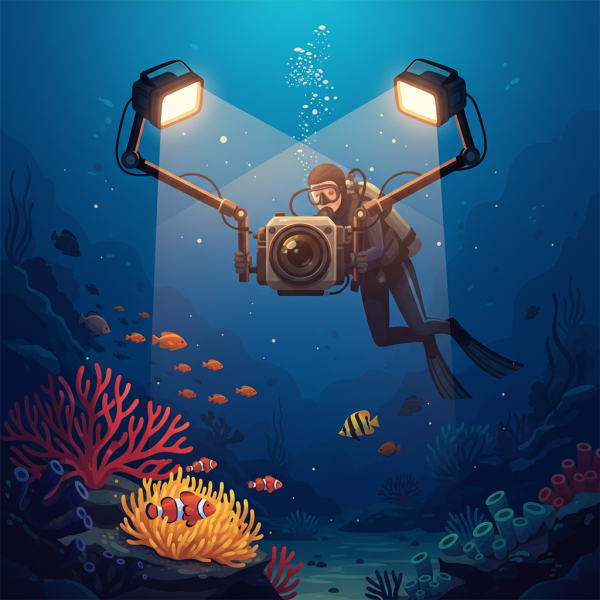
To mitigate backscatter, strobes and video lights are typically positioned off-camera, often on arms extended away from the housing. This allows the light to travel past the lens before hitting the subject. Common techniques include aiming lights slightly inward towards the subject (known as "snooting" or "cross-lighting") or positioning them wide and slightly behind the subject for dramatic rim lighting. Experimentation with angles and distances is crucial to achieve the desired effect and maximize clarity.
Summary
In conclusion, the unique optical properties of water necessitate the use of external lighting to capture the true beauty and vibrancy of the underwater world. Strobes are essential for still photography, providing powerful bursts of light that restore lost colors, freeze motion, and enhance detail. Video lights offer continuous illumination, vital for videography, and serve as invaluable focus aids for still cameras. By understanding the principles behind underwater light absorption and mastering the placement and use of these critical tools, photographers and videographers can transform their underwater images from muted blue affairs into stunning, color-rich portrayals of marine life, ensuring every captured moment reflects the ocean's authentic splendor.
Comprehension questions
 Why do red and orange colors disappear first when light penetrates the water column?What are the primary advantages of using strobes in underwater still photography?Besides providing continuous illumination for video, how else can video lights benefit an underwater still photographer?What is backscatter, and what technique is commonly used to minimize its appearance in underwater images?
Review Quiz
Next Lesson

Course Contents : Underwater Photography Deep Dive
- >> 3.
 Strobes and Video Lights in Underwater Photography