
A History of the One-Man Band
What you'll learn
 History of one-man bandsMechanical instrument integrationIngenious percussion mechanismsEvolution of multi-instrumental performance
Imagine a lone performer on a street corner, a whirlwind of motion, producing the rich, layered sound of an entire ensemble. This is the captivating world of the "one-man band," a phenomenon that transcends mere musical skill to embody a remarkable blend of human dexterity, creative vision, and mechanical ingenuity. Far from a simple novelty act, the history of the one-man band is a testament to the human desire to push boundaries, to craft complex acoustic machines that enable a single individual to become a symphony unto themselves. This article delves into the fascinating evolution of these unique performers and the ingenious mechanical solutions they devised to play multiple instruments simultaneously.
Early Roots and Simplistic Beginnings
The concept of a single musician playing more than one instrument is not new. Medieval minstrels might have sung while strumming a lute, or a folk artist might have played a fiddle while tapping their foot. However, these early forms were typically limited to two, perhaps three, instruments and relied more on inherent human coordination than on elaborate mechanical assistance. The true "one-man band" as we often picture it, laden with contraptions, began to emerge as instruments became more standardized and the desire for fuller sounds from solo performers grew.
The Emergence of Mechanical Aids
The late 19th and early 20th centuries marked a significant turning point. With industrial advancements making components more accessible, enterprising musicians began to experiment with attaching instruments directly to their bodies, often using repurposed parts. Street performers, vaudeville acts, and folk musicians sought ways to create a more impactful and unique presentation. This era saw the first crude but effective mechanical linkages that allowed for simultaneous percussion and melody. The goal was always to free up limbs for other instruments or to automate certain rhythmic elements.
Ingenious Instrument Integration
The core challenge for any one-man band is integrating a variety of instruments into a coherent, playable system. Over time, certain instruments became staples due to their adaptability:
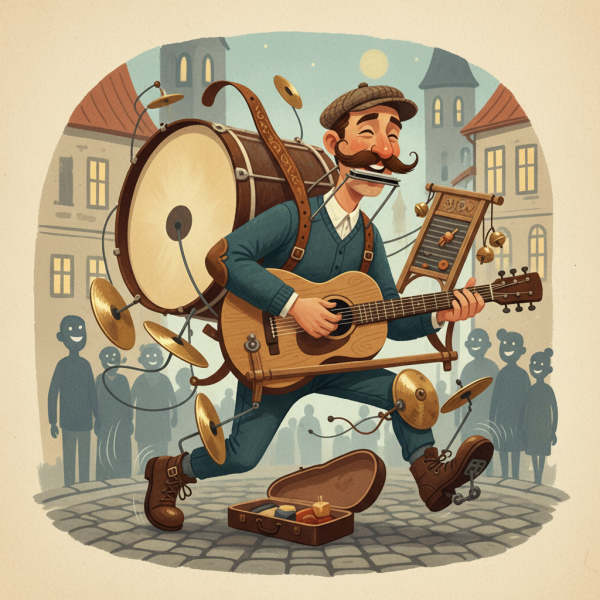
- Drums and Cymbals: The most common mechanical innovation. A bass drum was frequently mounted on the performer's back or front, with a foot pedal (often modified bicycle pedals or custom levers) operating the beater. Cymbals, sometimes a hi-hat setup, were often attached to a knee or elbow, or operated by another foot lever, adding rhythmic punctuation.
- Stringed Instruments: Guitars, banjos, or ukuleles were usually played by hand, requiring the performer to wear a harness or frame to hold the instrument in position, freeing one hand for strumming or picking, while the other might be involved in another action or chord changes if possible.
- Harmonica: The neck-rack harmonica, a simple yet brilliant invention, allowed the musician to play a melodic or harmonic accompaniment by simply turning their head, freeing both hands for other instruments. This became an iconic symbol of the one-man band.
- Miscellaneous Percussion and Sound Effects: Washboards, kazoos, bells, whistles, and even small xylophones were incorporated, often mounted within arm's reach or activated by additional foot pedals or body movements. These added layers of texture and flair to the performance.
The Mechanics Behind the Multi-Instrumentalist
At the heart of every elaborate one-man band setup lies a network of surprisingly simple, yet effectively interconnected, mechanical principles. Performers, often self-taught engineers, mastered the art of leverage, pulleys, and spring-loaded mechanisms. The design process was highly iterative, driven by trial and error, as each musician tailored their "rig" to their specific style and desired sound.
Consider the foot-operated bass drum: a pedal presses down, pulling a cord or pushing a rod that extends to the drum beater. A spring then returns the beater to its resting position. This basic principle is replicated and adapted for various other percussion elements. Similarly, small levers could trigger cymbals, or simple string-and-pulley systems could activate other sound-makers. The entire contraption needed to be robust enough to withstand vigorous performance, yet light enough to be portable and worn comfortably for extended periods.
The construction often involved:
- Custom-bent metal frames or wooden harnesses to support instruments.
- Modified bicycle parts, springs, and ropes for actuation.
- Ingenious placement to ensure all instruments were within reach and sight.
- Careful balancing to distribute weight and maintain performer mobility.
The brilliance wasn't in complex robotics, but in the elegant application of fundamental physics to create a symbiotic relationship between musician and machine.
Evolution and Enduring Appeal
While modern technology, such as looping pedals and electronic drum machines, allows contemporary musicians to create layered sounds with less physical apparatus, the classic mechanical one-man band retains a unique charm. The visible effort, the tangible connections between movement and sound, and the sheer spectacle of a person operating a multi-instrumental machine continue to captivate audiences. It’s a performance art that highlights human coordination, endurance, and a deep understanding of practical mechanics.
The tradition has been passed down through generations of buskers, folk musicians, and experimental artists, each adding their own spin to the mechanical marvel. From early 20th-century street performers to modern-day viral sensations, the one-man band remains a powerful symbol of independent musicianship and the relentless pursuit of creative expression through mechanical means.
A Symphony of Ingenuity
The journey of the one-man band is a captivating narrative of human innovation, showcasing how musicians transformed themselves into mobile orchestras through clever mechanical design. From humble beginnings relying on natural dexterity, the art evolved with the integration of foot-operated drums, neck-rack harmonicas, and custom-built harnesses. This required a profound understanding of levers, pulleys, and spring mechanisms, creating intricate systems that allowed a single individual to orchestrate a multitude of sounds. The enduring appeal of the one-man band lies in its remarkable blend of musical talent, physical coordination, and the sheer mechanical brilliance required to bring such a complex performance to life.
Comprehension questions
 What historical period saw a significant emergence of mechanical aids for one-man bands?Name three common instruments often integrated into a one-man band setup and briefly describe how they are typically played.What fundamental mechanical principles are frequently employed in the construction of a one-man band rig?How has the modern one-man band evolved with technology, and what is the enduring appeal of the traditional mechanical setup?