
Neon Sign Bending: A Fiery Art in the Age of Light-Emitting Diodes
What you'll learn
 The Craft of Neon BendingScience of Neon IlluminationImpact of LED TechnologyPreservation of Traditional Arts
In a world increasingly dominated by the sleek efficiency of digital displays and LED lights, there remains a luminous art form that relies on fire, human skill, and the subtle dance of noble gases: neon sign bending. This intricate craft, passed down through generations, transforms straight glass tubes into glowing masterpieces. It's a practice that demands precision, patience, and an artistic eye, creating bespoke signage and art installations that possess a unique warmth and character. However, as technology advances, this traditional skill finds itself at a crossroads, slowly being overshadowed by more modern, energy-efficient alternatives.
The Fiery Dance: Mastering the Glass
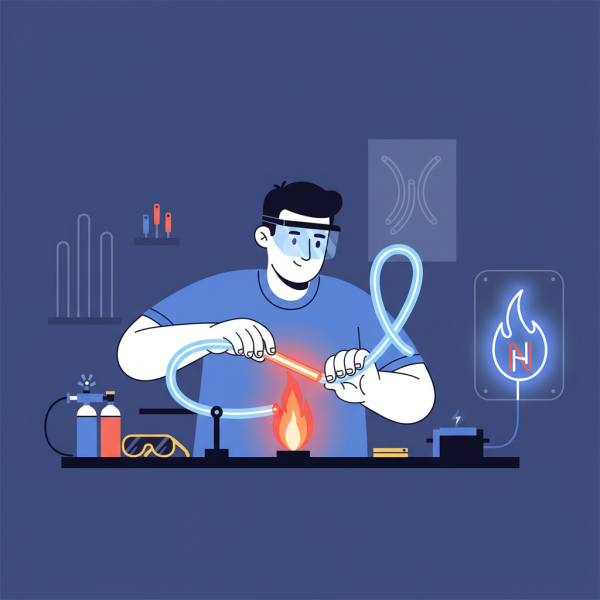
At its heart, neon sign bending is a specialized form of glassblowing. The process begins with straight, clear glass tubes, which are heated to their pliable point over a high-temperature ribbon burner. The glass bender, often working from a detailed paper pattern, carefully and continuously rotates the tube to ensure even heat distribution. With a keen eye and steady hands, they gently bend the molten glass into the desired shapes, blowing air into the tube at critical moments to prevent collapse and maintain a consistent diameter. This delicate balance of heat, rotation, bending, and blowing requires years of practice to perfect, turning inert glass into flowing lines of potential light.
The Essential Toolkit of a Neon Bender
The artisan's workshop is equipped with specialized tools, each playing a crucial role in the transformation of glass and gas into light. These tools are often as timeless as the craft itself, demanding mastery rather than mere operation.
- Ribbon Burner: A long, narrow flame used for broad, gradual bends.
- Crossfire Burner: Two opposing flames creating an intense, focused heat for sharper angles and smaller details.
- Patterns: Full-scale designs, usually on heat-resistant paper, guiding the bender's work.
- Electrodes: Glass components sealed to the ends of the bent tube, through which electricity will be introduced.
- Manifold System: A vacuum pump and gas filling station used to evacuate air from the finished glass shape and introduce precise amounts of noble gases.
- Transformers: High-voltage power sources that illuminate the final product.
Each piece of equipment is an extension of the bender's will, enabling them to shape and imbue the glass with life.
The Science of the Luminous Glow
Once the glass is bent, electrodes are fused onto the ends, and the air is meticulously removed from the tube using a vacuum pump. This is a critical step, as even trace amounts of impurities can affect the sign's longevity and color. Then, a precise amount of a noble gas—or a mixture of gases—is introduced. When high voltage is applied across the electrodes, it ionizes the gas within the tube. This excitation causes the gas atoms to emit photons, resulting in the characteristic glow.
Different noble gases produce distinct colors:
- Neon: The classic brilliant red-orange.
- Argon: Produces blue light, often used with a drop of mercury to enhance its intensity and create vibrant blues.
- Krypton: A pale green or off-white.
- Xenon: A lavender or bluish-white.
- Helium: Pink or orange.
For a wider spectrum of colors, the inside of the glass tubes can be coated with phosphors, which absorb the UV light emitted by the excited gas and re-emit it as visible light in various hues, from vibrant greens to deep purples.
The Shadow of Innovation: LEDs Emerge
While the beauty of hand-bent neon is undeniable, the craft faces significant challenges from modern LED technology. Light-Emitting Diodes offer a compelling alternative for many applications, leading to a noticeable decline in demand for traditional neon signs. LEDs are often:
- More Energy-Efficient: Consuming significantly less power.
- More Durable: Less prone to breakage than delicate glass tubes.
- Safer: Operating at lower voltages, reducing fire risk.
- Lower Maintenance: Longer lifespan with less flickering or dimming.
- Easier to Install: Often lighter and more flexible in design.
These practical advantages have made LEDs the preferred choice for many businesses and designers seeking cost-effective and robust illumination solutions. While LED flexible strips can mimic the appearance of neon, they often lack the unique, soft, continuous glow and depth that only true bent glass can provide. The warm hum and subtle imperfections of a handmade neon sign tell a story that mass-produced LED alternatives struggle to replicate.
Preserving the Flickering Flame
Despite the rise of LEDs, there's a growing movement to preserve the art of neon sign bending. Artists, educators, and enthusiasts recognize the unique aesthetic and historical value of this craft. Specialized workshops and schools continue to teach the intricate techniques, ensuring that the knowledge and skills are not lost. Many contemporary artists are also embracing neon as a medium, pushing its boundaries beyond commercial signage into fine art installations. Museums and historical societies are documenting the craft's legacy, showcasing its cultural impact and the extraordinary skill of its practitioners. This dedication ensures that while its commercial dominance may wane, the artistic and historical significance of neon bending continues to glow brightly.
Summary
Neon sign bending is a masterful craft involving the precise heating and shaping of glass tubes, then filling them with noble gases that glow under high voltage. This traditional art form, characterized by its unique tools and scientific principles of light emission, creates luminous signs with unparalleled character. However, it is increasingly challenged by modern LED technology, which offers greater energy efficiency, durability, and cost-effectiveness. Despite the commercial shift, dedicated efforts are underway to preserve and celebrate neon bending as a distinct and valuable artistic legacy, ensuring its unique brilliance endures for future generations to appreciate.
Comprehension questions
 What are the primary tools used in traditional neon sign bending?How do noble gases contribute to the glow of a neon sign, and what determines the color?List three reasons why LED technology is increasingly replacing traditional neon signs.What efforts are being made to preserve the craft of neon sign bending?