
The Crucial Art of Resting Meat
What you'll learn
 The Science of Sizzle and RelaxationJuice Redistribution: The Core ConceptThe Faux-Cambro Advantage: Longer Rests, Better ResultsPractical Tips for Resting Your Masterpiece
You've meticulously chosen your cut of meat, carefully prepared your smoker or grill, and spent hours tending to the fire, managing temperatures, and coaxing the perfect bark and internal doneness. As the delicious aroma fills the air, the moment of truth arrives: pulling the meat from the heat. But for many outdoor cooks, the rush to slice and serve can undo all that hard work. The final, often underestimated, step in the journey to BBQ perfection is the rest. It's not just a pause; it's a vital part of the cooking process that elevates your meat from good to legendary. This article will delve into the critical importance of resting meat, focusing on the science behind juice redistribution, and explain why a long, controlled rest, especially in a faux-cambro (a common cooler), is the secret weapon for achieving unparalleled tenderness and juiciness.
The Science of Sizzle and Relaxation
To understand why resting is so crucial, we first need to appreciate what happens to meat during cooking. When heat is applied, muscle fibers contract and stiffen. This contraction squeezes out moisture, pushing it towards the center of the meat where temperatures are lower. At the same time, connective tissues like collagen begin to break down into gelatin, contributing to tenderness. However, this breakdown and moisture movement create significant internal pressure and an uneven distribution of juices.
As the meat cooks, a steep temperature gradient forms. The exterior is much hotter than the interior, causing muscle fibers on the outside to contract more intensely and expel more moisture. This moisture, along with dissolved proteins, migrates inwards to the cooler core. If you were to slice into the meat immediately after removing it from the heat, these highly mobile juices, pooled in the center and under intense pressure, would simply gush out onto your cutting board. This results in a seemingly dry piece of meat, despite all the effort to keep it moist.
The Core Concept of Juice Redistribution
The magic of resting lies in juice redistribution. When you remove meat from the heat, the cooking process doesn't instantly stop. Carryover cooking continues for some time, with the internal temperature rising before it begins to gradually fall. During this crucial cooling phase, the contracted muscle fibers begin to relax. As they relax, they reabsorb much of the moisture and dissolved proteins that were pushed out during cooking.
This relaxation and reabsorption allow the juices to settle and redistribute themselves more evenly throughout the entire cut of meat. Instead of being concentrated at the center or pushed out entirely, they become integrated back into the muscle fibers. This process ensures that every bite is consistently moist and flavorful, rather than just the very center being juicy and the edges dry. It transforms a piece of meat that might otherwise be palatable into an incredibly succulent experience.
Think of it like a freshly baked cake. If you cut into it too soon, it crumbles and often seems dry because the internal structure hasn't set. Meat operates on a similar, albeit different, principle of internal settling and reabsorption.
Longer Rests, Better Results
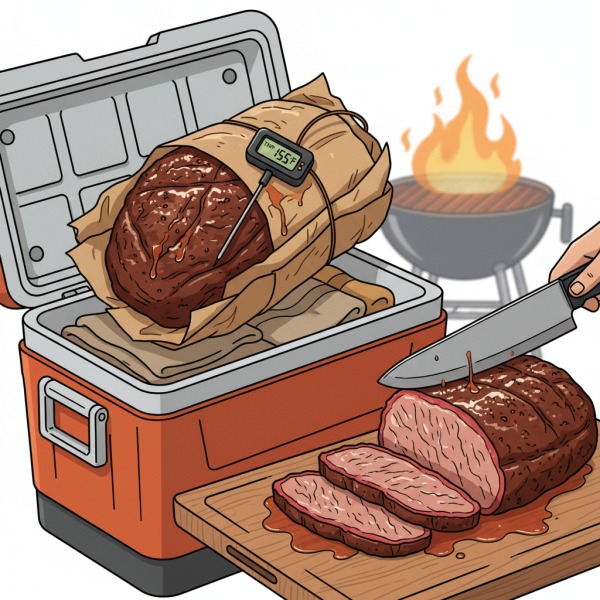
While tenting meat with foil on a cutting board provides some benefit, the ultimate tool for a superior rest, especially for larger cuts like brisket, pork shoulder, or large roasts, is the faux-cambro. A faux-cambro is simply an insulated cooler. These devices are designed to maintain temperature, and while commonly used for keeping items cold, they are equally effective at keeping things hot for extended periods.
Here's why a faux-cambro elevates your resting game:
- Slow, Controlled Cooling: The insulation of a cooler dramatically slows the rate at which your meat cools. This extended cooling period is absolutely crucial for maximizing juice redistribution. The longer the meat remains in a desirable temperature range, the more time the muscle fibers have to relax and reabsorb moisture.
- Even Temperature Drop: A cooler provides a more uniform environment for the entire cut. This prevents the exterior from cooling too rapidly while the interior is still hot, which could lead to uneven reabsorption. The gradual drop allows for a more consistent relaxation of muscle fibers throughout.
- Moisture Retention: By wrapping your meat tightly in heavy-duty foil or butcher paper and then placing it in a pre-warmed cooler (you can warm it with hot water, then dry it), you create a steamy, moist environment. This helps prevent the exterior of the meat from drying out and developing a tough crust during the long rest.
- Food Safety Window: For very long rests, a good cooler can keep the meat above the food-safe temperature of 140°F (60°C) for several hours, making it an excellent holding solution for large cuts like brisket that might finish cooking hours before serving time.
Why You Can’t Cut Early
The temptation to immediately slice into a beautifully cooked piece of meat is strong. The aroma, the anticipation – it's all part of the outdoor cooking experience. However, succumbing to this urge is arguably the biggest mistake an outdoor cook can make after investing so much time and effort. Cutting early is like puncturing a balloon full of water; all the internal pressure causes the liquid to burst out.
When you slice hot, unrested meat, the still-contracted muscle fibers and the un-reabsorbed juices, which are under significant pressure and highly mobile, simply escape. You'll witness a flood of delicious, flavorful liquid pouring onto your cutting board. This isn't just a visual disappointment; it means a significant loss of moisture and flavor from the meat itself. The result is a piece of meat that, despite being perfectly cooked to temperature, tastes dry, tough, and lacks the succulence it should have possessed. All the hard work you put into cooking it perfectly will be undermined by a moment of impatience.
Practical Tips for Resting Your Masterpiece
Mastering the rest is about understanding the principles and applying them practically. Here are some guidelines:
- Wrapping is Key: Always wrap your meat after cooking. For smaller cuts, a loose tent of foil is often sufficient. For larger cuts destined for a cooler, wrap tightly in multiple layers of heavy-duty foil or butcher paper.
- Pre-Warm Your Cooler: If using a faux-cambro, fill it with hot water and let it sit for 15-20 minutes, then empty and dry it thoroughly before adding your wrapped meat. This helps create a stable warm environment.
- Add Insulation: For even better heat retention, wrap the foil-wrapped meat in old towels or blankets before placing it into the cooler. Fill any remaining space in the cooler with more towels to minimize air pockets.
- Resting Times: The general rule is the larger the cut, the longer the rest.
- Small cuts (steaks, chicken breasts, chops): 5-15 minutes, tented with foil.
- Medium cuts (roasts, whole chicken): 15-30 minutes, tented or in a cooler for shorter rests.
- Large cuts (brisket, pork shoulder, large prime rib): 1 to 4 hours (or even longer, safely above 140°F / 60°C), ideally in a faux-cambro. Brisket, in particular, benefits immensely from a 2-4 hour rest.
- Monitor Temperature (for long holds): If holding for several hours, use a probe thermometer in the cooler to ensure the meat's internal temperature remains above 140°F (60°C) for food safety.
In summary, don't let impatience or a lack of understanding sabotage your hard-earned BBQ masterpiece. Resting meat is not an optional step; it's a non-negotiable part of the cooking process that ensures every bite is as juicy, tender, and flavorful as possible. By understanding the science of juice redistribution and leveraging tools like the faux-cambro, you unlock the full potential of your outdoor cooking. Embrace the rest, and your guests (and your taste buds) will undoubtedly thank you for it, experiencing meat that is truly worth the wait.
Comprehension questions
 What scientific processes occur in meat during cooking that make resting essential?How does juice redistribution work, and what role does it play in achieving moist, flavorful meat?What are the specific advantages of using a faux-cambro for resting large cuts of meat compared to traditional methods?What are the recommended resting times for small, medium, and large cuts of meat, and why is wrapping important?