
The Enduring Art of Dry Stone Walling
What you'll learn
 Ancient Craft HistoryDry Stone Construction PrinciplesSustainability and Environmental ImpactModern Relevance of Traditional Skills
Building Without Mortar
Imagine structures built thousands of years ago that still stand proudly today, defying the elements without a single drop of modern cement. This is the magic of dry stone walling, an ancient craft where skilled artisans meticulously fit stones together, relying purely on friction, gravity, and the art of interlock. For an online learning community interested in sustainable practices, historical crafts, and resilient construction, dry stone walling offers a fascinating deep dive into a timeless skill that continues to hold immense value in the modern world. It’s more than just stacking rocks; it’s an intricate understanding of geology, physics, and careful planning. This craft builds enduring beauty and functional strength, proving that sometimes, the simplest methods are the most powerful.
The Ancient Art of Dry Stone
Dry stone walls are found across the globe, from the prehistoric structures of the Mediterranean and British Isles to the agricultural terraces of Peru and Asia. Their prevalence speaks to their effectiveness and universality. These walls served diverse purposes: delineating property boundaries, containing livestock, supporting agricultural terraces, and even forming defensive fortifications. The techniques evolved independently in various cultures, all converging on the same fundamental principles: choose stones wisely, shape them as needed, and interlock them strategically to create a stable, self-supporting structure. The absence of mortar means the walls are flexible, able to absorb ground movement and temperature fluctuations without cracking, a characteristic that contributes significantly to their longevity.
Key Principles of Construction
Building a sturdy dry stone wall involves several critical principles, each contributing to the wall's stability and endurance.
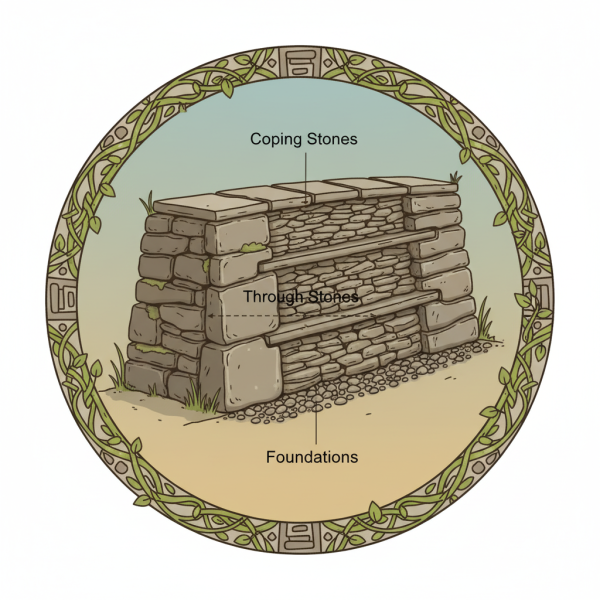
- Foundations: Every great wall starts with a solid base. A trench is usually dug to below the frost line, filled with small stones or hardcore to provide drainage and a stable, level footing. This crucial step prevents the wall from shifting or sinking over time, ensuring its structural integrity from the ground up.
- Hearting: This refers to the core fill of smaller stones packed tightly between the outer "face" stones. Hearting binds the wall together, prevents the outer stones from shifting inwards, and ensures the entire structure acts as a cohesive unit. Proper hearting is essential for the wall's long-term stability and resilience.
- Through Stones (or Tie Stones): These are long stones that span the entire width of the wall, tying the two faces together. They are strategically placed at regular intervals along the wall's height and length. Through stones act like internal anchors, preventing the faces from bulging outwards and distributing pressure evenly throughout the structure, making the wall incredibly robust.
- Coping Stones: The topmost layer of stones, coping stones, serve several purposes. They protect the hearting from weather erosion, add weight to the top of the wall to compress the lower layers, and often create a distinctive aesthetic finish. They can be laid flat, upright, or in various decorative patterns, often dictating the final look and character of the wall.
Tools of the Trade
While the craft itself feels ancient, the tools used by dry stone wallers are surprisingly simple and timeless.
- Waller's Hammer: A specialized hammer with one broad, flat face for striking and a chisel-like peen for shaping and splitting stones.
- Safety Glasses and Gloves: Essential for protecting eyes from stone chips and hands from rough surfaces.
- String Line and Level: Used to ensure the wall is built straight and level, maintaining a consistent batter (the slight inward slope of the wall faces).
- Picks and Pry Bars: For moving and positioning larger stones.
- Tape Measure: For checking dimensions and consistency.
Environmental Benefits
Dry stone walling is inherently sustainable. It uses locally sourced materials, typically fieldstones cleared from the land, minimizing transportation costs and carbon footprint. These walls integrate seamlessly into the landscape, providing habitats for various flora and fauna, unlike impervious concrete structures. Their permeability allows for natural water drainage, reducing runoff and supporting local ecosystems. The durability of dry stone walls means less need for repair or replacement, further contributing to their environmental friendliness.
Why Learn Dry Stone Walling Today?
In an era focused on sustainability, resilience, and connection to traditional skills, dry stone walling offers immense appeal.
- Practical Application: Build durable garden features, retaining walls, property boundaries, or even small outbuildings.
- Environmental Stewardship: Contribute to sustainable land management and biodiversity.
- Mindfulness and Craftsmanship: Engage in a meditative, physically rewarding activity that hones problem-solving skills and patience.
- Historical Preservation: Help preserve and revive an endangered heritage craft.
- Community Building: Many dry stone walling associations offer courses and workshops, fostering a strong sense of community among enthusiasts.
Summary
Dry stone walling is an ancient, enduring craft that builds stable structures without mortar, relying on the clever interlocking of stones. This article explored the historical significance of dry stone walls, detailed the fundamental construction principles like solid foundations, effective hearting, and the crucial role of through and coping stones. We also touched upon the simple yet effective tools used by wallers, highlighted the significant environmental benefits of this sustainable practice, and underscored the numerous reasons why this valuable skill remains relevant and rewarding to learn in the modern era.
Comprehension questions
 What are the primary reasons dry stone walls have been used across different cultures and throughout history?List three environmental benefits associated with building dry stone walls.Besides practical applications, what personal and community benefits can learning dry stone walling offer today?